
A Pastor Reflects on Bible Prophecy, Global Power, and the World Today
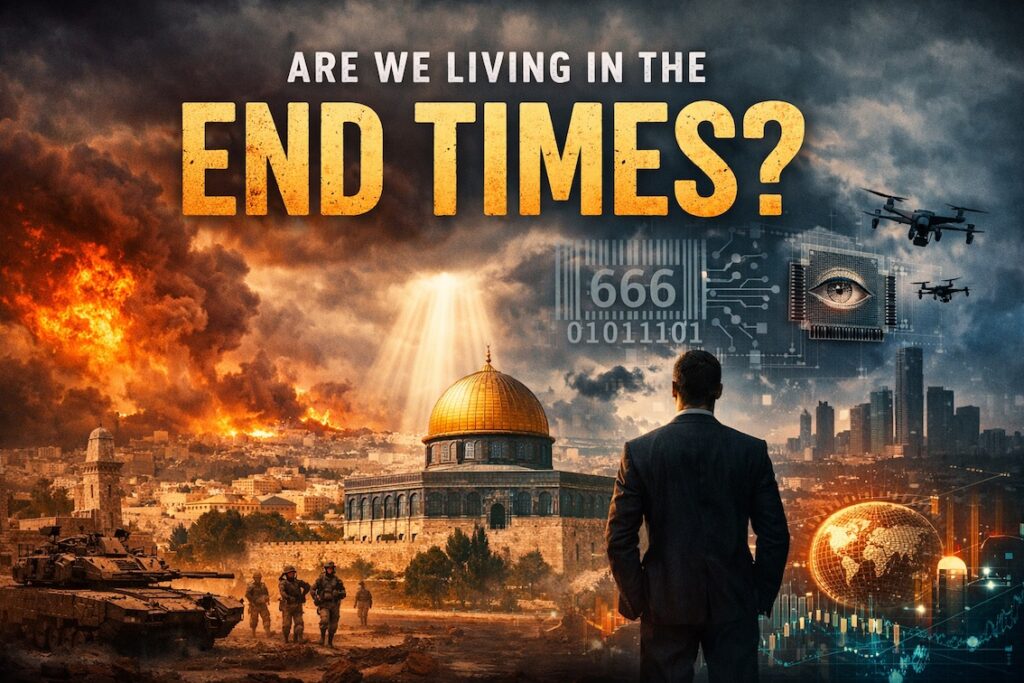
Are we living in the end times?
It’s a question that seems to surface whenever the world feels unstable. Wars (and rumours of wars) escalate, economies wobble, the world seems to spin faster than ever, and suddenly ancient biblical prophecies start sounding surprisingly modern. Is now the time to run to the hills?
In the early 1990s I heard a travelling prophecy teacher named Barry Smith who came to the UK from ‘down under’ asking just that kind of question, are we living in the end times?
The former school teacher with a wry sense of humour was well known at the time for seminars, books and videos – still mostly available – about Bible prophecy and the possibility that the world was moving toward the kind of events described in Daniel, Matthew and Revelation.
Smith spoke of global systems, economic control, and the need to be ready for the possibility that history was moving toward a dramatic conclusion. Rather than some wild eyed prophetic figure, he was actually very matter of fact in his delivery, yet I remember much of what he said more than thirty years later.
With hindsight, it’s clear some of Barry Smith’s predictions lacked the foresight he claimed; particularly in that like many prophecy teachers of that era, he suggested that the return of Christ might be near the turn of the millennium. Those dates came and went quicker than you can say Y2K.
Jesus himself warned against trying to calculate the timing of his return: “About that day or hour no one knows.” (Matthew 24:36) So Christians should always be cautious about anyone claiming to have decoded the exact timeline of the end of the world as we know it. But when you go back and actually read Smith’s books or even pull out the VCR and watch what he said rather than the summaries or caricatures, some of the questions he raised about the direction of the world feel less far-fetched today than they did in the 1980s or 1990s.
The Three Systems That Would Be Needed
In books like Warning and Second Warning, Smith argued that the system described in Revelation would require three unified things to exist, globally:
- a political framework capable of global influence
- an economic system that could operate internationally to ‘control nations, through controlling oil, and control people, through controlling food.’
- a religious system or spiritual influence – opposed to the truth of the gospel, even if it used much of the same language.
He reasoned that the Antichrist described in the Bible could not be revealed and exercise worldwide authority unless the infrastructure for global influence already existed. In the Cold War world of the 1980s, that idea sounded speculative. Today our world is more interconnected than anyone then could have imagined.
Global financial systems are tightly linked. Political decisions in one country influence continents. Technology connects (influences and monitors) billions instantly.
The Move Toward a Cashless Economy
One of Smith’s most memorable claims was that “Cash Will Crash – in a Flash.”
He believed that global elites would create systems whereby physical money would eventually disappear, replaced by electronic systems to track transactions.
At the time that sounded far-fetched, we mostly still paid with notes, coins, or cheques. But now I can’t remember the last time I did that – can you? Here in the UK contactless payments dominate everyday spending. Many people carry little or no cash at all but my digital fingerprint opens access to my digital bank balance through facial ID on my phone instead. How convenient!
Even more significantly, central banks around the world are exploring digital currencies issued directly by governments. Supporters say these systems could make payments faster and more efficient, but many worry that digital currencies could eventually allow financial transactions to be monitored in ways that were never previously possible to be rewarded or restricted in line with social credit systems.
Smith connected these ideas with Revelation 13, which describes a system where: “No one could buy or sell unless they had the mark.” Christians disagree strongly about how that passage should be interpreted, including my friend Dr Ian Paul who is always worth reading on Revelation. Still, it is striking that the kind of global digital economy Smith imagined even as he talked about cheques disappearing is now here.
Global Crises and the Centralisation of Power
Another theme in Smith’s teaching was that major global crises tend to accelerate political change. He predicted that events like economic collapse, war, or global emergencies could push nations toward stronger international coordination, cooperation and eventually control.
Again, that sounded speculative at the time, but recent decades have shown how crises reshape the political landscape and have knock on effects for us all.
The financial crisis of 2008 triggered unprecedented cooperation between central banks. Since then the evidence that we are managing our debt by creating more is not only true as individuals but also whole nations.
The Covid pandemic saw governments around the world introduce emergency powers and coordinated responses many saw as Orwellian, and the established church was only too willing to be seen to finally lead the way in one way: strict compliance to government mandates.
Global challenges such as climate policy increasingly involve international agreements and frameworks that override not only individual choices but national sovereignty, in order to meet dates for the end of the world set in much more apocalyptic and fearful tones than Barry Smith ever communicated.
Now none of this proves a hidden global conspiracy, but any student of history knows that crises and wars are often started or exploited by the powerful to cover their tracks, increase their wealth and lead to greater centralisation of their own power.
Technology and Control
Smith also spoke frequently about computers creating systems of identification and monitoring. In the 1980s he was referring to things like barcodes and our National Insurance number and birthdates, and a new system just starting to emerge of satellite navigation to pinpoint locations.
We now live in a world of:
- biometric passports
- facial recognition – increasingly used by law enforcement
- digital identity systems
- AI-driven data analysis
None of these automatically fulfil biblical prophecy either, but they do demonstrate that large-scale monitoring and control of economic activity including taxation and spending is technologically possible in ways previous generations could barely have imagined.
The Middle East Question
For centuries, students of biblical prophecy have noted that the Bible places Israel and Jerusalem at the epicentre of end-time events. Why is a country the size of Wales the most contested piece of land on the planet?
Some interpreters believe Daniel 9 refers to a future leader who ‘does whatever he pleases’. He will confirm a seven-year peace agreement involving Israel – before eventually betraying it.
In that interpretation, the Antichrist is a tyrant who wants to be known instead as a peacemaker – who manages to broker a deal where others have failed.
Christians disagree about the details of these passages but if that interpretation is correct, then a dramatic peace agreement in the Middle East could represent more than a diplomatic breakthrough. It could signal the beginning of a significant prophetic period.
The Problem With End Times Conversations
Of course, conversations about the end times often go wrong in two opposite ways.
Some people disregard the situations the scriptures were written in contextually and in history and treat every headline as proof that prophecy is being fulfilled tomorrow. Every war, every new technology, every political development becomes another “sign.”
Others dismiss the whole subject entirely, as if the Bible had nothing meaningful to say about the future at all.
But the New Testament takes a different approach, neither encouraging panic nor permitting indifference. Instead it calls believers to watchfulness without speculation, and readiness without fear.
The Real Question
Christians have always believed they are living in the “last days,” because the New Testament describes the entire period between Christ’s resurrection and his return in those exact words.
Every generation has wondered whether the end might come in their lifetime.
Every generation that tried to set a date has been wrong (so far!).
But the goal of prophecy and warnings about the end times was never to help Christians predict the future, and map out what happens toward it with precision. Rather it was to help Christians remain faithful no matter what the future brings.
Jesus didn’t tell his followers to obsess over timelines. He told them to stay ready: “Therefore keep watch, because you do not know the day or the hour” living with our light shining bright and full of oil.
The Most Important Answer
That’s why Barry Smith never ended without asking people the really important question, and what their own answer was to it:
Not whether we can identify the moment Christ will return, but whether when he does – he will be able to identify us as his followers. Will we be found ready to meet him because we have trusted our lives to him as Saviour and Lord?
That’s another thing about those teachings in the 1990s I still remember very clearly.
After all the charts, the prophecies, the warnings about global systems and the future of the world, he would always end the same way. He would reassure people that those who trusted Jesus would always have their needs met in this life and the next whatever happens on the Earth – and whoever seems to be in charge.
Then Smith would take a simple small wooden cross and hold it up high, and say something like this:
“Friends, I’m not here tonight just to talk about prophecy.
I’m here because Jesus Christ is coming again.
The question is not whether these things will happen.
The question is: are you ready?
The Bible says that every one of us has sinned and fallen short of the glory of God. But the good news is that Jesus Christ died on the cross for our sins and rose again so that we can be forgiven.
I’m not trying to scare anyone into heaven.
But I don’t want anyone to go to hell.
Tonight you can come to Christ.
Tonight you can be forgiven.
Tonight you can know that when Jesus returns you are ready to meet him.”
He said the most important issues of the Bible and prophecy and his ministry were not really about decoding headlines or predicting world events – it was all about pointing people to Jesus.
Whatever we think about the details of end-times timelines, the central message of the Bible is remarkably simple:
History is not random, God has a plan.
Jesus Christ will return.
And every human life ultimately stands before him.
The most important date for you and me is the day we decide to trust and follow Jesus – so the goal of biblical prophecy was never to help Christians predict the future with precision, but to help everyone recognise the urgency of the gospel.
The real question, in the end (literally – and a new beginning starts then) is not whether we can identify the exact moment Christ will return, but whether we are ready to meet him when he does. Because whatever the future of the world may hold, God is the one who holds it, and the invitation of the cross lifted high still stands:
Come to Jesus, now. Live for him and with him, now and forever.
(If you have done that now – go here next)
Frequently Asked Questions About the End Times:
Are we living in the end times?
Christians have believed they are living in the “last days” since the resurrection of Jesus (Acts 2:17; Hebrews 1:2). The Bible teaches that Christ will return, but he himself was clear that no one knows the exact day or hour of his coming (Matthew 24:36). Every generation should therefore live ready and waiting rather than predicting.
What does the Bible say about signs of the end times?
Jesus spoke about wars, global unrest, deception, and spiritual decline as characteristics of the period before his return (Matthew 24). These signs are given so that believers remain watchful and faithful in every generation.
Who is the Antichrist in the Bible?
The Bible says that many antichrists have gone out into the world since the real one came – and also describes a future figure who will oppose Christ and deceive many people (2 Thessalonians 2; Revelation 13). Some interpretations suggest he may first appear as a leader who brings peace or stability before revealing his true nature. Christians disagree about the details, but Scripture is clear that Christ ultimately defeats every evil power.
Where does the Middle East fit in Bible prophecy?
Many biblical prophecies focus on Israel and Jerusalem, which is why events in the Middle East often attract attention from students of prophecy. Some interpreters connect Daniel 9 with a future peace agreement involving war with Israel, Christians hold different views on how these passages should be understood.
Discover more from Anthony Delaney
Subscribe to get the latest posts sent to your email.