We Are Gluing Down the Wallpaper While the Foundations Shift
IT INCREASINGLY FEELS LIKE MUCH OF WESTERN SOCIETY
It increasingly feels like much of Western society is trapped arguing about surface-level issues while deeper structural changes gather underneath us.
Every day brings another outrage cycle, another confected political psychodrama, another online tribal battle, or some policy or story to keep us divided and distracted. Meanwhile AI is already beginning to reshape industries, careers and assumptions about work itself, and unemployment especially among the young is at its highest in over a decade (when I was young, bands wrote protest songs about this, what happened to that? The songs I hear seem more distracted or self absorbed than ever). Many Western nations are wrestling with rising debt, ageing populations, struggling productivity and ever increasing pressure on public services.
Those realities are connected, and require calmer, wiser and more serious conversations than we often seem capable of having.
History Suggests Economies Need More Than Spending
I’m no economist (unlike my son of whom I am immensely proud), but the older I get and the more history I study, the more I notice patterns – seeing that prosperous societies tend to share certain characteristics.
Economies flourish when individuals are encouraged and rewarded to create, innovate, build and take risks. Healthy businesses and organisations grow because they meet real needs, solve real problems and generate genuine value. In that kind of culture, work is respected, skills are developed and effort is seen as worthwhile.
Young people especially need a vision of a future worth aiming for. They line up to be trained, apprenticed and equipped because they think, “I want to build something meaningful. I want a stake in that future” – not simply, “How do I get by today?” or “What benefits can I claim?”
Strong nations are shaped by long-term thinking – where there is enough freedom, incentive and optimism for people to invest, solve problems and create opportunities not only for themselves, but for the next generation too.
Over time though, the repeating pattern is that successful societies can drift into assuming prosperity is automatic. Wealth is treated as inevitable rather than something fragile that must be renewed by governments and people together taking responsibility, making the right sacrifices and operating from earned trust. The idea that markets or economies simply sustain themselves regardless of culture, values or behaviour is naïve.
Debt grows quietly until the numbers become almost impossible to comprehend. What is £3 trillion – between friends?
Public spending rises continually, along with ever more inventive ways to not say the word tax. Bureaucracies expand gradually. Short-term political pressure to win the next election often crowds out the courage needed to reform systems everyone knows are draining us now and compounding problems for the future.
Of course public services and infrastructure matter enormously. Compassionate societies care deeply about healthcare, education and support for vulnerable people, but eventually we have to face the difficult truth, that wealth must first be generated before it can be distributed.
If debt, dependency and spending continue to rise, pressure slowly builds within the system. For a while we can find other ways to present the numbers and bamboozle the electorate so it all appears manageable, but eventually, again, ‘She’s gonna blow captain!
We can’t blame everything on foreign wars while domestically we see signs of this strain caused by successive governments across the West. Housing availability and affordability collapsing for younger generations, politicians magicking unreal money while borrowing ever more heavily not only to maintain existing commitments but to pay off the ever increasing debt like so many ‘consumers’ (I hate that word), especially the poor on our estates have to.
These are not just political problems. They are structural ones that ask questions about the kind of people we are and the kind of society we want to be.
Orwell’s Warning Still Feels Relevant
When everything starts spinning like this, some reach instinctively for the handle labelled “more government control.” Others assume the answer is simply “leave everything to the market.” Neither response seems sufficient to me.
Because of course capitalism has many flaws (all such problems are in the end people shaped). Markets alone do not automatically produce healthy communities, moral behaviour or equitable flourishing. When profit becomes the sole driver – what does it profit, to lose the soul?
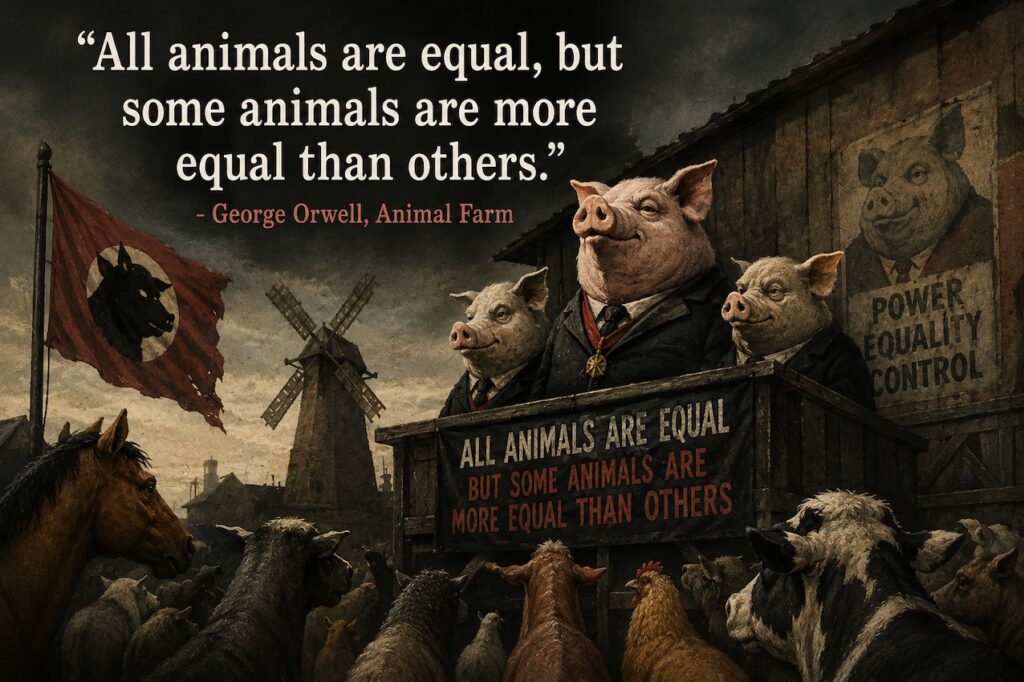
But history also suggests that heavily centralised systems often create problems of their own, captured brilliantly by George Orwell in Animal Farm, an eye opener from my school days written as a cautionary tale. Heartfelt revolutions often begin from the best of intentions, with legitimate grievances and noble ideals. Fairness. Equality. Liberty. Protection from exploitation. Yet history has proved over and over that as power concentrates, bureaucracies develop from systems meant to liberate people into controlling them, ‘for their own good’ of course. The genius of the story is not about pigs on stilts enjoying and retaining the best for themselves, Animal Farm shows human nature, that:
“All animals are equal, but some animals are more equal than others.”
The problem is not simply capitalism or socialism. Right or Left can both end up in the wrong place because the deeper problem is that every human system eventually reflects and outworks human sin.
The Bible Does Not Condemn Wealth – But Warns About Greed
Money itself is not the problem. The Bible does not say money is evil, just that loving it leads to evil. Scripture does not condemn the rich simply for being rich. Our God is rich!
Abraham was wealthy. Job was wealthy. Lydia was wealthy. Joseph of Arimathea was wealthy.
Wealth can build hospitals, fund innovation, create jobs, support families, fuel generosity and enable enormous good, so the issue in Scripture is never wealth itself but greed, exploitation, self sufficiency and pride – the worship of Mammon, the idolatry and illusion that possessions can replace God.
Tax The Rich!
In most modern economies, a relatively small percentage of high earners and business creators contribute a very large proportion of the tax base. That is not ideology. It is simply how tax systems work.
According to HMRC and the Office for Budget Responsibility:
The top 10% of earners pay around 60% of all income tax
The top 1% pay around 30% of all income tax receipts
But if highly productive people, entrepreneurs, investors, innovators and wealth creators increasingly feel punished for building, risking and succeeding, societies eventually weaken their own economic foundations.
That does not mean wealthy people should be beyond criticism. We’ve seen corporations (privately or publicly owned) detach from communities as executives reward themselves excessively through financial systems and instruments disconnected from ordinary working life.
But businesses do not appear by magic. Jobs do not create themselves. Innovation requires risk. Investment requires confidence. Growth requires people willing to build.
And if enough of those entrepreneurial people stop doing so, relocate elsewhere or simply decide the sacrifice is no longer worth it, the consequences do not just affect “the rich.” The pressure lands on everybody else through weaker growth, lower investment and higher tax burdens spread across ever fewer productive people.
The great strength of free enterprise is when ordinary people spot opportunities, solve problems, build businesses and create value. Human beings made in God’s image are remarkably inventive when they are given freedom, incentives and responsibility.
Incentives Shape Cultures
That does not mean every tax rise destroys an economy or every welfare system creates dependency. Serious conversations require more nuance than that. But it does mean societies need to think carefully about balance.
How do we maintain strong safety nets without weakening incentives to contribute? How do we support vulnerable people while still valuing responsibility and work? How do we encourage entrepreneurship without allowing exploitation? How do we fund public services sustainably in ageing societies with rising costs?
Not easy questions. But avoiding them helps nobody.
Britain Needs Better Conversations
In the UK especially, we need more mature public conversations than we have been getting for a generation.
We should be able to discuss immigration thoughtfully without descending into fear, racism or hostility. Immigration has brought enormous contribution, skill and energy to Britain across generations. But it is also reasonable for societies to ask practical questions about infrastructure, housing, integration, social cohesion and long-term sustainability.
We should also be able to discuss welfare systems honestly. We absolutely must support those who are vulnerable, disabled, sick or genuinely unable to work. Scripture is clear about caring for those in need. But we also need systems that encourage contribution, opportunity, training and the dignity or work rather than trapping people in long-term or even generational passivity where possible.
And we need political leaders willing to think beyond the next news cycle. Too much modern politics is media reactive and shaped by fear of public backlash rather than serious long-range planning.
Made in the Image of a Creative God
The Bible begins with a Creator God.
God builds. Designs. Orders. Creates.
And we human beings are made in His image. Which means meaningful work is not merely about income. Creativity, stewardship and contribution are woven into human identity itself. Work is a blessing not a curse because before sin entered the world, Adam was already given responsibility for purpose and contribution.
Christianity does not teach that human worth depends on productivity. Human beings have inherent value because they bear the image of God, not because they maximise economic output. But Scripture also consistently affirms the dignity of our reflecting our Maker as we cultivate and serve, build and steward.
Jesus Worked With His Hands
Surely it’s no accident that Jesus spent most of His earthly life in manual work. Before public ministry, He built things. Worked with His hands. Lived an ordinary working life, family business, a trade he learned for the money they earned.
There is something important about that first thirty years of God on the earth working with rough hands, in an age increasingly obsessed with ease, status and a digital life. Ironically, many practical and relational skills may prove more resilient in the AI era than huge sections of administrative knowledge work once considered secure.
Paul wrote: “Make it your ambition to lead a quiet life: You should mind your own business and work with your hands…” 1 Thessalonians 4:11 NIVUK
What a striking phrase – “make it your ambition”!
Ambition today is usually associated with visibility, influence, gaining platform and status, but Paul points us toward honest work, responsibility and peaceful living. There’s real dignity in the very act of building, serving, fixing, creating, raising families, learning skills and quietly carrying responsibility without demanding applause or even a 5 star review. .
The same tentmaking Apostle Paul wrote, “If anyone is unwilling to work, neither should he eat.” He’s not condemning those who can’t work. The New Testament consistently commands care for the vulnerable, poor and excluded. But he’s challenging a handout mindset detached from responsibility.
Acts 2 Was About Generosity, Not Coercion
This is also why Acts 2 won’t fit modern political categories but points to a radical new way to be human together as the Kingdom of God comes to earth.
The early church shared radically and generously so that nobody among them was abandoned in need. But this generosity flowed voluntarily from transformed hearts, not state coercion.
The gospel draws people to God, changes us from the inside out, and turns us out to face others.
That is why neither socialism nor capitalism fully solves the deeper problem. Both may be among the better human systems – certainly preferable to despotic regimes – but neither can ultimately redeem human nature itself. Economic systems matter enormously, yet cultures are ultimately shaped by values, virtues and vision.
“The church is the society of Christ.” John Calvin
As Tim Keller said, the church is meant to be a radical new culture within the culture – “a city within the city.” At its best, it will create communities where people work, serve, give, create and care for one another freely, not because they are forced to, but because love reshapes what they value and because they themselves have freely received so much.
And in an AI-shaped future full of uncertainty, that kind of community will become more important than ever.
Why Not Subscribe Before You Go So You Don’t Miss Any Posts?
Your Next Read about the future and the church tied to this article is here