
Mimic Others, Make a Difference, Multiply Impact, and Build Meaningful Legacy
Why do some people seem stuck trying to please everybody, while others build lives of deep purpose, impact and peace? Over years of leadership, ministry and life experience, here’s something I’ve noticed.
“For everything there is a season, and a time for every matter under heaven.” Ecclesiastes 3:1
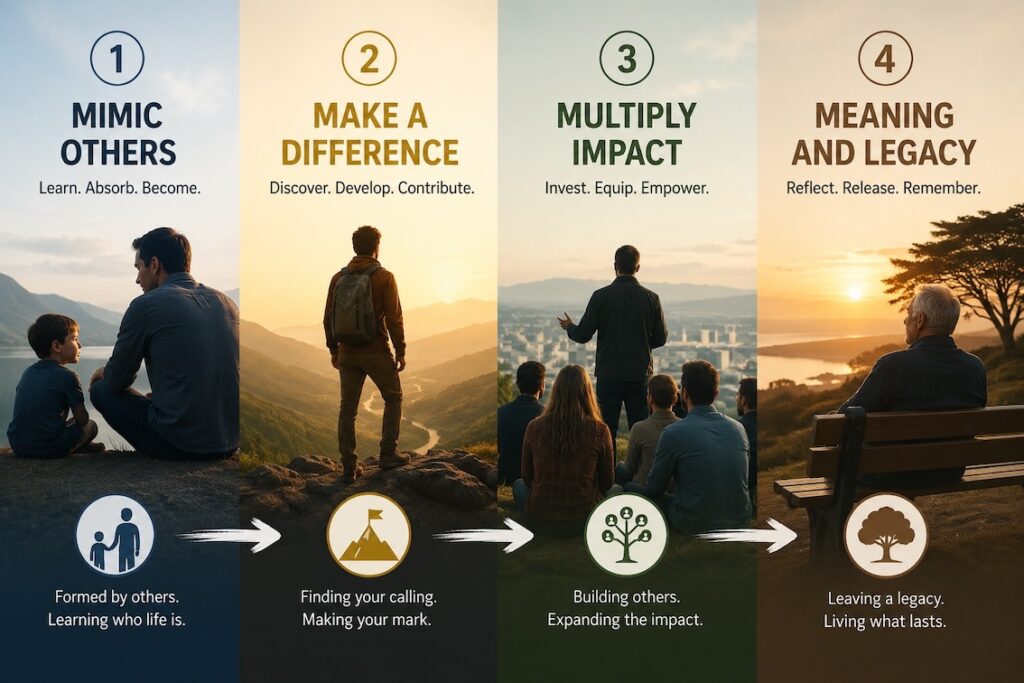
Life moves in seasons, not neatly or perfectly. Often not even forwards. Sometimes we grow through breakthrough. Sometimes going through disappointment. Sometimes wandering through wilderness. But over decades of serving as a police officer, pastoring churches, leading teams, walking through success and sadness, acclaim and failure, and watching people grow spiritually, emotionally and relationally, I keep seeing four broad stages emerge:
- Mimic Others
- Make a Difference
- Multiply Impact
- Meaning and Legacy
If by God’s grace we live long enough, most of us will move through all four in some way. Some people progress quickly. Some get stuck for years. Some loop backwards after trauma or loss. Some mature professionally while remaining emotionally or spiritually immature. But recognising these seasons of life helps explain:
- why priorities shift,
- why certain ambitions lose their shine,
- why relationships change,
- and why God often grows us more through stretching than comfort.
Stage One: Mimic Others
We all begin life by imitation. Children absorb words, habits, fears, attitudes, behaviours and beliefs long before they think independently. We learn by watching others so that eventually we can function in the world around us. That’s formation, and spiritually, imitation is how it works too. Paul wrote both:
“Bad company corrupts good character.”
1 Corinthians 15:33
And:
“Follow my example, as I follow the example of Christ.”
1 Corinthians 11:1
We all need examples, and we are all good or bad ones at times. Parents shape us. Teachers shape us. Churches shape us. Friends shape us. Culture shapes us. But eventually imitation must mature into conviction.
Some people spend their lives trapped in approval-seeking, asking:
- What will people think?
- Will I still belong?
- Will I be accepted?
- Will this upset anyone?
That creates fragile people, because applause is unpredictable.
King Saul is a painful example. When confronted by Samuel over his disobedience, he finally admitted:
“I was afraid of the men and so I gave in to them.”
1 Samuel 15:24
That’s what happens when acceptance matters more than obedience.
At some point maturity requires you to realise you will never please everybody, so it’s better to live for ‘the audience of One’ who was praised by crowds at the start of one week and crucified by them at the end of it. If your identity depends on human approval, life will constantly destabilise you.
We must all imitate but Paul asked a great diagnostic question, “Am I now trying to win the approval of human beings, or of God?” Galatians 1:10
Stage One is necessary. But eventually you must stop borrowing everybody else’s convictions and start owning your own.
Stage Two: Make a Difference
This stage is full of energy, ambition, experimentation and discovery.
You begin asking:
- What am I called to?
- What am I good at?
- What kind of life do I want?
- How can I make a difference?
This is often the season of:
- risk-taking,
- launching projects,
- travelling,
- discovering gifts,
- succeeding sometimes,
- and failing a lot.
You usually have to move out of your Mum’s bedroom for this one.
Spiritually, this is where Moses leaves the palace for the wilderness, David faces Goliath, Peter steps out of the boat and Paul goes apostolic.
But here’s one of the great lessons of maturity:
Growth is not discovering what you can do.
Growth is discovering what you should give your life to.
That means accepting limitations rather than denying them.
I learned early that football wasn’t my calling. I could run fast, but not with a ball at my feet. That’s not failure. It’s feedback. So I became a runner instead.
Modern culture tells us to keep our options open, maximise every opportunity and become whatever we want. But eventually reality teaches us:
- time is limited,
- energy is limited,
- attention is limited,
- and gifting is limited.
That’s not negative. It’s healthy.
Just because something is possible doesn’t mean it’s your purpose.
Paul wrote:
“I press on toward the goal for the prize of the upward call of God in Christ Jesus.”
Philippians 3:14
Notice – not every goal. The goal God had given him.
Calling always requires commitment.
You can’t keep saying you’re an entrepreneur if you never finish anything. You won’t build healthy relationships while “keeping your options open.” Most of the good things in life exist on the other side of commitment.
People stuck in perpetual Stage Two are always reinventing, pivoting, searching and chasing the next thing.
Eventually you must decide:
- this matters more,
- this is where I’m called,
- this is worth the cost.
Jesus lived with extraordinary clarity about His mission.
“I must proclaim the good news of the kingdom…”
Luke 4:43
“For the Son of Man came to seek and to save the lost.”
Luke 19:10
“My food… is to do the will of him who sent me and to finish his work.”
John 4:34
Not every demand deserved His yes.
And not every opportunity deserves yours.
Stage Three: Multiply Impact
This is where life becomes less about independence and more about interdependence, investment and impact.
You stop asking:
“What could I do?”
And start asking:
“What should I build?”
This stage is about deepening commitment and focusing your life around:
- your deepest convictions,
- your strongest relationships,
- your clearest calling,
- and your most fruitful gifts.
For this to happen, some things have to go:
- draining relationships,
- unrealistic fantasies,
- endless distractions,
- useless habits,
- and endless experimentation.
You realise that every meaningful yes requires many chosen noes.
Friendship does. Marriage does. Parenting does. Leadership does. Ministry does.
You cannot build strong while living scattered.
This stage shifts from making a difference personally to multiplying impact through others.
I probably struggled most with this stage until I learned to love it most.
Jesus preached to crowds but invested deeply in disciples.
Paul told Timothy:
“Entrust to reliable people who will also be qualified to teach others.”
2 Timothy 2:2
Notice the multiplication:
Paul → Timothy → reliable people → others.
That’s how movements outlive individuals.
Seeds have to fall into the ground and die to produce much fruit.
One of the hardest truths of Stage Three is accepting the trade-offs of multiplication.
You can’t have:
- complete freedom and deep rootedness,
- constant novelty and long-term fruitfulness,
- comfort and significant impact.
The problem with multiplication is that it often feels like subtraction.
Fruitfulness costs something.
Jesus said:
“Whoever wants to be my disciple must deny themselves…”
Luke 9:23
Deep impact requires deep surrender.
Stage Four: Meaning and Legacy
Eventually life changes the questions again.
Not:
“What can I achieve?”
But:
“What truly matters?”
This stage moves beyond ambition into wisdom, stewardship, succession, mentoring and faithfulness.
Healthy legacy is not clinging to your importance. It’s preparing others well.
David eventually realised that true success comes when:
“One generation commends your works to another.”
Psalm 145:4
But eventually we all must face this truth:
All earthly influence fades.
We are meant to make a difference in this life, but we will never become immortal through our achievements.
Ecclesiastes reminds us:
“Generations come and generations go…”
Ecclesiastes 1:4
And this is where the gospel reshapes everything.
Because the ultimate purpose of life is not:
- approval,
- achievement,
- influence,
- or even legacy.
It is faithfulness.
Jesus never commanded us to be impressive.
He called us to be faithful.
| Stage | Core Question | Core Temptation |
|---|---|---|
| Mimic Others | “Can I be accepted?” | Approval |
| Make a Difference | “Can I achieve something?” | Endless striving |
| Multiply Impact | “What should I build?” | Fragmentation |
| Meaning & Legacy | “What truly lasts?” | Clinging to significance |
The Upward Call
It’s good to reflect on the stages of life.
But if we are truly going to move forward well, we must learn to look upward – not merely outward to others or inward to ourselves.
Stage One says:
“I need approval.”
Stage Two says:
“I need achievement.”
Stage Three says:
“I need significance.”
Stage Four says:
“I need my legacy to last.”
But:
Approval’s flaky.
Success fluctuates.
Influence flickers.
Legacy fades.
Christ remains.
The gospel is never about earning your worth through performance.
It is about grace.
Before Jesus ever sent the disciples to change the world, He first called them:
“that they might be with him…”
Mark 3:14
That matters most because it is the only thing that lasts forever.
Final Thoughts
Transitions between these stages are rarely smooth, often they are triggered by something out of left field:
- grief,
- disappointment,
- burnout,
- betrayal,
- suffering,
- failure,
- or loss.
The Bible is full of such wilderness seasons. So wherever you find yourself today:
- learning,
- striving,
- building,
- mentoring,
- reflecting,
- or preparing others,
find Him there.
Don’t just ask “What stage am I in?” Ask, “Lord what are you forming in me through this season?”
Because ultimately the goal of life is not becoming successful.
It is becoming the kind of person who loves to be with Jesus, reflects Him faithfully and helps others do the same.
“Lord, save us from merely succeeding in life, help us become faithful people who reflect Jesus well in every season.”
——————–
SIGN UP
About 6,000 people will land here on my blog this week, each somewhere in their own season of life. Some will subscribe and travel with me awhile. Why not join them?
Your Next Read To Take This Further
Discover more from Anthony Delaney
Subscribe to get the latest posts sent to your email.