
Estimated reading time: 8 minutes
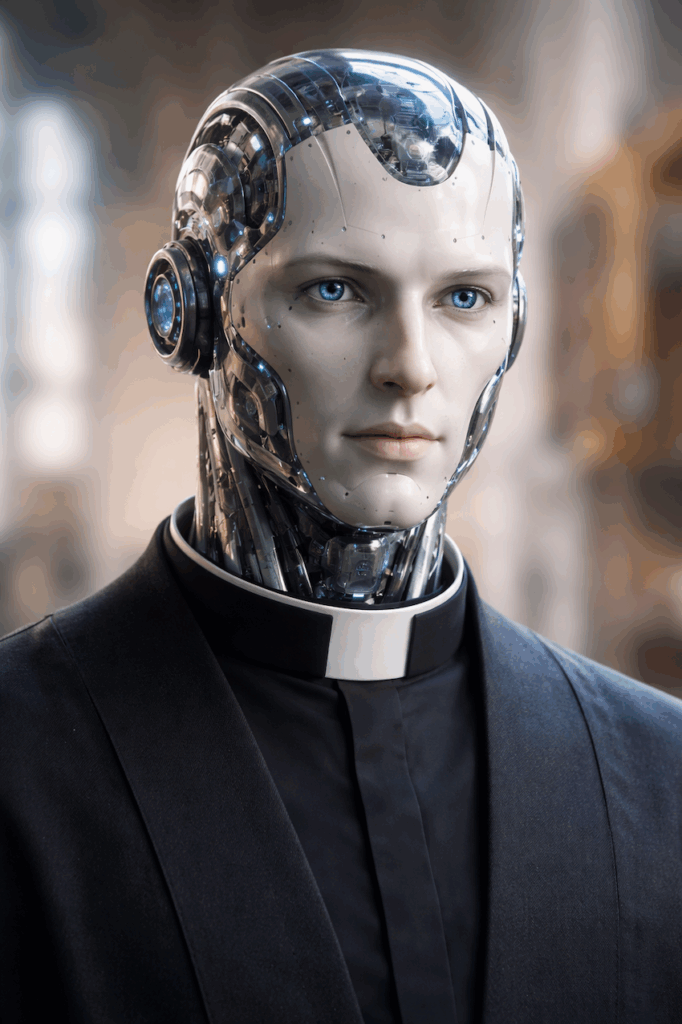
RoboRev? Which Pastors Will Be Replaced by AI – And Which Won’t
Will AI replace Pastors?
There is growing fear about the next 3–5 years of work. People are asking hard questions:
- Which jobs are going to go?
- Which roles will be automated?
- What will be made redundant?
- Who’s next?
Some are predicting AI -Armageddon, complete destruction of the future of employment as we now now it, qualifications that don’t matter, entry level jobs disappearing, whole careers disrupted, ladders pulled up, and the pace of change accelerating every month so much faster than almost anyone realises. A recent Spectator article I read said the legal profession is completely in denial.
RoboRev?
But I wonder whether many have asked the question in relation to the church and the future of pastoral ministry Will Vicars, ministers, Pastors (whatever you want to call us) have a future – and if so, what will that look like? Here’s my take.
AI won’t replace pastors – but it will reveal them
My prediction after 30 years of ministry through incredibly complex, challenging and changing times?
AI won’t replace pastors.
It will expose what kind of leader someone really is.
And the dividing line will not be tech literacy, but theology.
Paul described his ministry in Ephesians 3:2 when he speaks of: “the administration of God’s grace that was given to me, for you.”
The word Paul uses for “administration” there is oikonomia and it doesn’t mean bureaucracy. It means stewardship, being entrusted in the household, given responsibility for which you will be held to account – grace is something he’s received from above – now it is to be handled faithfully and handed on to others, below.
Paul is saying:
I’ve been given something from heaven
to steward on earth
for you.
That’s what the world needs now, and while the future will always change, that prophetic apostolic gift he goes on to describe will never be irrelevant. Which leads to the decisive distinction for our historical moment:
Yes, AI can do administration.
But it cannot administer God’s grace.That’s the job given from the very beginning to those made in His image, to exercise kingdom dominion as his co-regents.
AI can manage systems.
It cannot steward or lead with divine revelation.
It can process information and reprocess knowledge.
It cannot receive something from God himself and faithfully give it to others.
Some won’t be replaced – they’ll be lost another way
Many pastors will go of course, but not because they’ve been replaced by AI.
They will instead:
- Burn out through chronic over-functioning
- Blend in to the world by trading what’s prophetic for what’s popular or ‘progressive.’
- Blow up their lives through unresolved wounds, and their ministries through uncontrolled temptations.
AI doesn’t cause such failures, but it may accelerate exposure – especially where ‘leadership’ has settled into:
- Maintaining the system rather than saving and stewarding souls
- Preserving tradition rather than pursuing mission
- Repeating failing patterns rather than reimagining the future
Administration vs stewardship
AI is astoundingly good at tasks. Those who wisely embrace it find it can use it to
- Streamline admin
- Improve ideas
- Assist preparation
- Speed execution
Good pastors can use AI – without guilt or fear.
But Paul never spoke of ministry as a list of tasks entrusted to him. His ministry was a grace given. He doesn’t say: “I was given responsibility for religious output.”
The danger of “safe pair of hands” leadership
When organisations and institutions feel under pressure, the instinct is to appoint safe pair of hands leaders:
- Low risk
- Highly compliant
- Administratively competent
- Conflict-avoiding
It feels prudent and responsible and it’s at the heart of the demise of denominations because in seasons of constant disruption, playing safe often does the opposite and only accelerates decline. What is required now more than ever for the Church is not more leaders who say “computer says no”, but those who dare to say “I have a dream.”
Paul’s “dream” for the church in Ephesians did not come from trend data analysis or predictive tools. This mystery was revealed by God, not Grok. He had wisdom and revelation from above, not an algorithm.
AI is always going to outperform humans at preserving systems, but it will never outperform Spirit-led leaders at receiving revelation and envisioning heaven’s future on earth.
AI, bots, and discipleship – friend not foe
Many ministries are already using digital tools to:
- Help answer honest spiritual questions
- Guide seekers through Scripture
- Provide prayer prompts and next steps
- Scale gospel conversations globally
Organisations like Christian Vision (CV) are already doing this and more with remarkable fruit from digital evangelism and follow-up at scale.
Used wisely, AI can:
- Extend evangelistic reach
- Lower barriers to spiritual curiosity
- Support discipleship pathways
- Serve people we would never otherwise meet
You can make a bot that reminds people to pray and read their Bible. But tools don’t disciple people.
People disciple people.
What AI cannot do – and never will
AI can never:
- Receive revelation in prayer
- Break through in warfare intercession
- Shepherd wounded people through suffering
- Confront sin with love and courage
- Open mysteries entrusted by God
- Pay the personal cost of obedience
AI can imitate language, but cannot release God’s Word with spiritual authority. AI can analyse Scripture, it cannot tremble before it. AI can remix sermons, it cannot say, “This is what God gave me – to give to you.”
Henri Nouwen once described Christian leadership as the way of the wounded healer – not the information expert above others, but the fellow servant who has lived through their own pain and offers it to God – for the healing of others. This happens as vacation, not automation. AI can process information, optimise systems, even mimic language – but it can’t carry wounds, speak prayers for healing, sit with suffering, or offer compassion forged through someone who knows what it is to have received it.
AI can make you look better than you are before people, but the future church will not be led primarily by those who appear strongest, smartest, or most efficient. God will always use those who are present, prayerful, and imperfectly human – leaders who know their weakness and therefore rely on grace received and stewarded.
The pastors who will not be replaced
The pastors who endure, who understand oikonomia rightly will be:
- Stewards of mysteries, not regurgitators of machine learning
- Prayerful, not just productive
- Vision-carriers, not system-maintainers
- Rooted in fresh revelation, not trapped in repetition
They will gladly let AI manage admin, wisely let AI assist discipleship, but never confuse maximum efficiency with ministry faithfulness.
The kind of church AI can never replace (Ephesians 3:10)
I’m going to have to pray, think (and write on the blog) more on this, because Paul doesn’t stop with the pastor. Later in the chapter he widens the lens and says that “Through the church, the manifold wisdom of God is made known – not only to the world, but to rulers and authorities in the heavenly realms”. In other words, God’s plan revealed to His leaders – is displayed through His people.
This means despite technological advances the church is not:
- A content platform
- A delivery system or
- A spiritual goods and services provider
AI is being heralded as a means by which the manifold intelligence of man is made known on the earth. But the church is something so much grander – a living, embodied, Spirit-filled community through which heaven resounds and hell trembles as she displays God’s manifold wisdom.
The kind of church God is building can never be replaced because it is not a learning machine, it’s a living body.
The final word Paul himself gives us
Paul then returns to himself as he says that preaching the gospel was a grace given to him, too. Not a job, an office, a role or a function. A gift – entrusted.
The grace that changed him, now revealed through the church, was a download from heaven, not a search box – a spiritual mystery, centred on Christ.
This is why pastoral ministry can be AI enhanced, but never truly automated or outsourced. Because preaching the gospel is not content delivery or knowledge, the power of God unto salvation, or else it is a false gospel.
Grace received – and grace administered. Ministry is given by God to His people, handled faithfully on earth when passed on for others.
Though AI opponents complain about how much power it uses I am grateful for now it help us with research, structure, formatting a phrase. But as the churches growing and multiplying fastest in the world (often without technological enhancement) know – real power is unleashed when a called, consecrated, Spirit-filled person stands before the church to say:
“This was given to me from heaven
to steward on earth
for you.”
So what should leaders focus on now – to future-proof ministry?
If AI is accelerating change rather than causing it, this question becomes urgent and the answers must be practical.
1. Deepen the inner life
Future-proof ministry begins and ends in the secret place with
- Prayer that not only asks but listens, hears and declares
- Scripture meditated on to shape souls, not just sermons to tickle the ears
- A life that carries revelation with integrated authority and awed humility
AI answers questions and rewards productivity. God answers prayer and rewards pursuit.
2. Strengthen character and accountability
Too many leaders crash and burn already and the greatest threat to ministry is not untrammelled technology, its unmanaged temptations. Don’t spend all your time with ChatGPT, it’s not really your friend, instead we must get out more and model the Christian life we offer by building:
- Honest relationships
- Clear boundaries
- Rhythms of rest
- Structures of accountability
Grace can only be stewarded by those continually amazed by it, so
3. Become a steward of mystery, not just a messenger
We are not just ‘content curators,’ we are entrusted by heaven to:
- Open Scripture faithfully
- Discern the moment spiritually
- Speaking truth with love and courage as we
- Administer God’s grace appropriately to real people
In the age of AI, automation, and acceleration, the future does not belong to RoboRev but to men and women who can stand before God, receive grace, and then stand before people and steward it faithfully.
That kind of church will always be needed, and in God’s economy, those kind of people will never be redundant.
_____
READ NEXT – Your One Page Plan To Develop Leaders
Discover more from Anthony Delaney
Subscribe to get the latest posts sent to your email.